30s and 40s War 40s Fashion
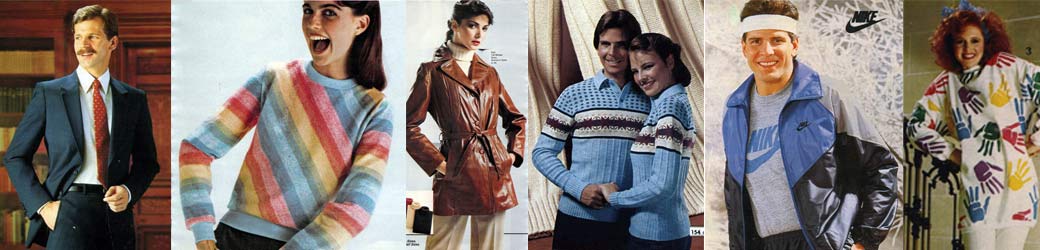
1980s way tin be commended for its creativity. Some fashion designers abased history, some borrowed from information technology, while others tried to blueprint the future. Designers abased all convention — and their creations were interesting to say the least.
The early 80s were somewhat subdued in color, where we see a lot browns and tans and oranges. Blocky shapes were everywhere and dressing like a tennis actor was the cool matter to do.
Velour was hot and velvet was even hotter. For both men and women, the waistline was a little high.
But let's face up it, early 1980s way was very similar to the late 1970s. In 1983 there was a slight 1950s-fashion throwback, especially in women'south dresses.
By the mid-80s, pop music stars like Cyndi Lauper were ushering in an entirely new manner — one that many people associate with the 1980s to this mean solar day.
Bright colored accessories like sunglasses, bangles and hoop earrings were a necessity. Teased hair, loud makeup and neon were an of import part of this style. This style was plainly more popular with the younger oversupply.
But that didn't mean "regular" women in the 1980s couldn't have fun. It was an uncommonly flexible time when a adult female could wear peel-tight cotton stirrup pants with leggings and a giant turtleneck sweater one day — and parachute pants with a small v-neck top and a high-waist belt the next.
Society'south love for brand was epitomized by its inexplicable love for wearing Coca-Cola brand clothing in 1987. MTV had a huge bear on on fashion, every bit teens across the U.S. were tuning in to watch music videos starring wildly dressed celebrities. Suddenly information technology became much easier for a fad to spread across the land faster than wildfire.
By the late 80s, Nike had grown into one of the near profitable clothing companies in the world. Like Coke vs. Pepsi, Reebok vs. Nike was the able-bodied wear battle of the decade. With the help of Michael Jordan, Nike won the war. In 1988, every kid had to accept a pair of Air Jordans and a Chicago Bulls baseball cap.
If you ever hear someone talk well-nigh "Cosby sweaters", they are referring to sweaters that were most popular in 1989. Past so, women's clothing had gotten considerably more baggy as women clamored for styles that hearkened back to a more conservative time.
The best example of late-1980s for boys is Zack Morris (Mark-Paul Gosselaar) from Saved by the Bell. 1 expect at a 1989 catalog feels like a glimpse into the troublemaking teen's bedroom floor.
QUICK REFERENCE LINKS
1980s Style Timeline
1980 | 1981 | 1982 | 1983 | 1984 | 1985 | 1986 | 1987 | 1988 | 1989
1980s Manner: In-Depth Profiles
1980s Way: Pictures
In-Depth 1980s Fashion Profiles
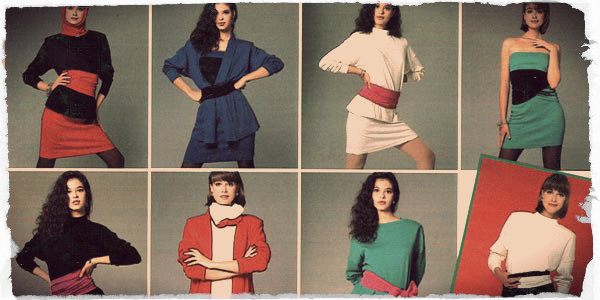
1980s Fashion: Women & Girls »
Women's fashion in the 1980s was a period of incredible creativity, though some could contend that information technology got out of hand. Learn more than hither with over l pics.
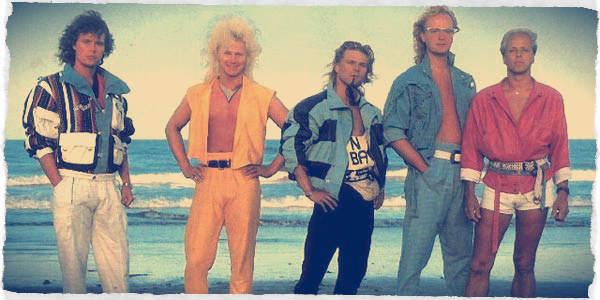
1980s Style: Men & Boys »
Men's style in the 1980s was dominated past sportswear, corduroy, turtlenecks and itchy sweaters. Check out our huge 80s mode picture gallery here.
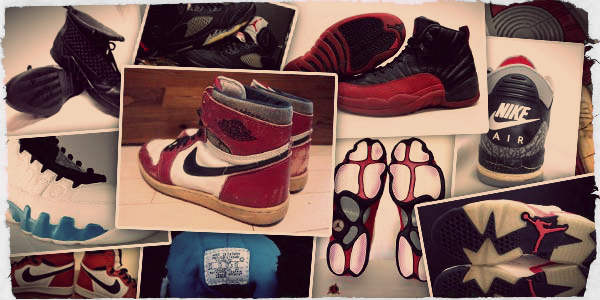
Nike Air Jordan Shoes: History & Pictures (1985-1999) »
The Nike Air Jordan brand is the most iconic brand in the world. Acquire more than about the history of Air Jordan shoes with pictures of original, vintage kicks.

Giorgio Armani: Fashion Designer Facts & History »
Giorgio Armani is considered a modern legend in the mode industry. Initially known for costly designer suits, his later collections were less expensive.
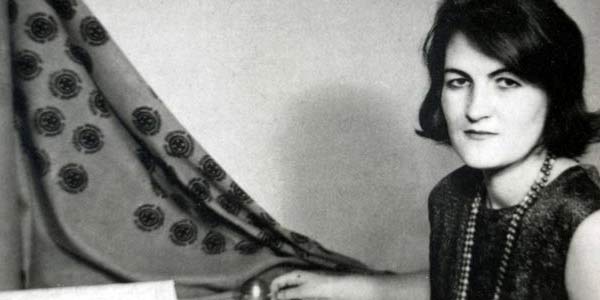
Laura Ashley: Fashion Designer Facts & History »
Laura Ashley was known for her rustic, romantic styles that embraced the Welsh countryside. She embodied a perfect combination of nostalgia and innocence.
Manner in 1980
Women'south vesture in 1980 ran the gamut from conservative to opulent fantasy. Many designers reached back in history for inspiration. The looked to the Heart Ages, the Renaissance, the Victorian era and fifty-fifty the Peruvian Indians for something "new." A few advanced designers took their cues from futurism and designed wearing apparel that looked like uniforms for infinite travel.
1980 witnessed a revival of the archetype "preppie" look that began in New England prep schools in the 40s and 50s.
International mode was influenced by American sportswear more then in 1980 than it had been since the jeans of the 60s. Western dress began to make a improvement as well.
China saw its first American mode testify in 1980, when Halston presented his large collection. Chinese reactions ranged from polite admiration to outright dismay.
Designers did what they could to try to please women. They opted for choice. Hemlines bounced up and downwardly and there was no prescribed length — mean solar day or night. Shapes ranged from slim to extremely total and blousons returned.
Velvet was popular around the clock and women wore lace with tweeds and leather. Clothes could exist made of any color, with emphasis on blocks and asymmetrical bands of two or more colors.
Men's dressing styles changed very petty in 1980. One noticeable evolution for men'due south fashion was that information technology was becoming more than acceptable for men to wearable sport coats and slacks to events that previously required a adjust.
Fashion in 1981
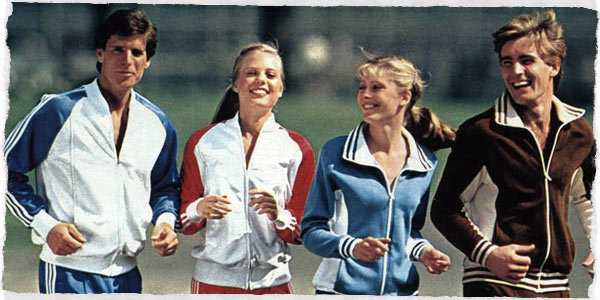 The rule in 1981 was a lack of rules. Hemline length was at present completely up to the wearer's preferences. Some women wanted curt, some wanted long, but nigh concluded upwardly somewhere in the heart.
Designers got extremely inventive with pants. Armani, Valentino and other introduced artistic shapes similar balloon pants, breeches, Bermuda shorts and styles that were puffy around the hips and taped around the ankles.
These styles were more popular in Europe than in the U.S., where women continued their support of culottes. These culottes were varied in design, with some resembling skirts, while others looked similar pants.
Rise prices led to the rise in entreatment to multi-purpose clothing. People wanted to wear their piece of work pants effectually the house and vice versa.
Gold, copper, brass and other metals appeared on blouses and skirts. Accessories such every bit handbags, shoes and belts sparkled. Leather was also quite popular in 1981, with new processes making some leather every bit soft as silk.
Style in 1982
Way, traditionally the province of rich and leisured women, subtly changed its focus in 1982. The most successful styles were moderately subdued, in durable fabrics that required little upkeep and in quiet, basic colors.
At that place were two chief reasons for this development. 1.) The worldwide recession put extravagant dress out of reach for a good portion of the population and 2.) a growing number of women continued to join the workforce.
With more women moving in executive roles in the workplace, the need for concern suits increased.
Perry Ellis, then i of the "ascension stars" of fashion, was successful with his near-ankle lengths. Bill Blass and Adolfo — favorites of Nancy Reagan — kept their hemlines around the knee. Calvin Klein and Ralph Lauren both favored calf-length clothes.
In 1982, sportswear is adapting well to everyday contemporary needs.
Donna Karan and Louis Dell'Olio are inducted into the Coty Hall of Fame. Feathers replaced beads and sequins every bit the latest extravagance.
Style in 1983
Japanese designers dominated the fashion world in 1983. Featuring the likes of Yohji Yamamoto, Kansai, Rei Kawakubo and Mitsuhiro Matsuda — unknowns in the western world up to that point — the formless, dark elegant styles influenced designers around the world.
The new mode was innovative in its approach. Clothes were cut so full that there was no need for sizes. 1 size for everyone. There was no endeavor to define a figure and their colors were more subdued. This loose-fitting philosophy encroached in all types of clothing, including American sportswear, which had became noticeably less course-fitting.
Resort clothing, as well known as summerwear, was quite pop in 1983. Light-colored slacks and Hawaiian shirts were a common leisure outfit.
Basketball shoes and athletic-licensed apparel was extremely popular. Everywhere you looked you saw at least one person wearing a t-shirt emblazoned with the emblem of their favorite team. Nike was preparing to make its move every bit a major histrion in the fashion industry.
T-shirts were probably the near pop casual piece of habiliment in 1983. Sleeves were curt, the material was typically a super-thin, cotton wool-poly blend and the shirts were tight-plumbing equipment (only getting a petty bigger) Many t-shirts had funny or crude sayings on them. The decrease in the cost of wear manufacturing meant that in that location were more t-shirt designs available than ever before.
Denim jeans were hugely pop and corduroy also enjoyed some success. Pop pants manufacturers included Lee, Levi's, Wrangler, among many others.
Fashion in 1984
In 1984, women's fashion was dominated by what was at the fourth dimension known equally menswear. A typical outfit would consist of a sports jacket, trousers and a big overcoat. Many woman completed the expect by cutting their hair short. Information technology was bold, risky, and very much in style.
Giorgio Armani could exist called the father of this new expect, as his Fall 1984 collection ushered information technology into the public eye. It was such a expert year for Armani he won the Golden Eye Award from the international style printing. The boyish look wasn't only in Italy notwithstanding, information technology was showing up in French and British catalogs too.
The masculine await was adopted by all the major American manufacturers also. The menswear concept offered a clean, simple style for women to wear the same clothes in their professional person lives as their personal ones.
Separates were very important. A sweater could exist swapped for a blouse; jackets could be worn with skirts or pants and large overcoats could on elevation of anything.
Of course, a counter-trend developed. Some women rejected the new look and instead opted for very tight vesture that left little to the imagination.
Past the fall of 1984, searing hot colors like pink, chartreuse and citron yellow began to appear in dresses, suits and coats.
London, which had dominated the youth movement in the 1960s, was staging a comeback. Zandra Rhodes, Jean Muir, Katharine Hamnett, Trunk Map and Jasper Conran were showing up in American stores alongside fashions from Paris and Milan. London was back.
Adrienne Vittadini won the honour for women's way while Andrew Fezza won the men's category. Special awards were given to 1000 & J Savitt for jewelry.
Way in 1985
Manner in 1985 was so wide-ranging it's nigh impossible to embrace it all in a few paragraphs. To eddy it down to its essence, the fashion world had four major hubs: Paris, Milan, London and New York City. The style you liked dictated which city you were ownership your designs from. All four were quite different from each other. The only real abiding was a wide shoulder. Everything else, color, fabric, cut, was fair game.
In Paris, the top designers were Yves Saint Laurent, Karl Lagerfeld (Chanel), Hubert de Givenchy and Emanuel Ungaro. Italy featured top designers Valentino and Giorgio Armani. The top American designers in 1985 were Geoffrey Beene and James Galanos. Calvin Klein, Ralph Lauren, and Anne Klein set the tone for sportswear, simplifying their styles to achieve a more mod look. London was proud of successful newcomers Betty Jackson and Sheridan Barnett.
But possibly the nearly successful newcomer in 1985 was Anne Klein & Co.'s Donna Karan. After surprisingly leaving Anne Klein to exit on her own, Karan's habiliment line was a smash hit. Her clothes perfected the art of feminine composure in casual form. One prime number instance is her method of tying a sarong skirt effectually narrow pants.
Also notable, 1985 saw the end of the Coty American Fashion Critics' Awards, which for 43 years had celebrated the manufacture'south most promising and successful designers.
Information technology was around this fourth dimension that fashion was starting to splinter off into so many separate factions that it's difficult to summarize. There were very many different designers who were successful in their own way. No longer was information technology normal for people to all dress similarly. In that location were dozens of trends that came and went, some stayed for several years.
The bottom line: the fashion industry was changing forever.
Way in 1986
The long, full wool coat emerged the fall of 1986 as everyone'due south favorite fashion. It became the unifying link in a still-fragmented fashion where, increasingly, anything goes. The big coat covered long flaring skirts, skinny knee-begetting skirts, pants, bulky sweaters, shirts, blouses and even jackets.
The search was on for fresh looks. In London, newcomer Alistair Duncan Blair, whose offset collection was acclaimed for its stylish, tailored look.
Romeo Gigli was the new name in Milan. Trained as an architect, he brought a simple, erstwhile-fashioned charm to sweaters and skirts. Also in Italia was Zack Carr, a former Calvin Klein banana, who created spare, minimalist designs for Giorgio Armani and Valentino.
The most promising new designer in the U.S. was 23-twelvemonth-sometime Marc Jacobs who released fanciful designs that ran from battle jackets in printed satin to princess dresses with petticoats.
New York sportswear designers were widely praised for the contemporary approach to fashion. The upgraded their dress past using luxury fabrics such as cashmere and alpaca rather than by adding frills. The leading names in this category were Calvin Klein, Ralph Lauren, Donna Karen and Perry Ellis — who died on May 30 at age 46.
Mink was the fur of choice in 1986. Equally women moved into better-paying professions, they were able to afford more than high-terminate furs.
Manner in 1987
The big news in fashion in 1987 was the resurgence of the short skirt. For some time, fashion designers had insisted that anything goes when it came to the length of hemlines. Virtually women had accepted this approach and some alternated long skirts with short ones. Other women concentrated on the length they preferred.
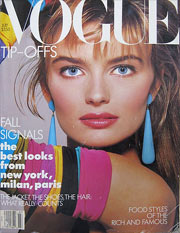
1987 Fashion: Faddy Magazine Cover (July)
When fashion collections for fall 1987 were unveiled in the leap, however, it was clear that designers were surprisingly unanimous in their back up for the curt hemline.
The new hemlines bared the knees and sometimes went to mid thigh. The virtually popular skirt lengths measured to 21 inches from the waistband to the hem. The shorter lengths were fashion choice for teenagers, simply women of all ages began revealing their knees.
Although the new shorter skirts were designed for fall, women jumped the gun and began rolling up the waistbands or turning up their hemlines on their longer outfits to accommodate the new trend earlier the shorter fashions hit the stores.
Stores didn't become crazy. They still offered longer skirts, merely information technology was clear, brusque was in.
Fashion in 1988
The extreme femininity displayed in 1987 was a petty more subdued in 1988. Colors became a but more classic and clothes were a bit slimmer, merely the youthful exuberance from the previous year remained.
More than always, women demanded diverseness. Last twelvemonth, the brusque skirt was nearly the only matter available in stores. But some women weren't comfortable showing then much leg, or others couldn't clothing short skirts at work or school due to clothes codes. They needed some conservative hemlines to choose from.
In the bound of 1988, Chanel introduced a scattering of suits with long, narrow, elegant skirts. The next month Donna Karan released some summer dresses with hemlines that ranged from the knee t the mid-calf.
Sales were downwardly in 1988, with nearly retailers blaming either the stock market crash or the fad that was the miniskirt.
Trousers made a strong comeback in 1988, being featured in high manner collections from Calvin Klein and Giorgio Armani.
Yves Saint Laurent was in what some considered a slump when he released what was arguably his best collection in 1988. Lacroix made chimera skirts that very pop for a moment.
Armani set the pace for soft-tailored suits. Ralph Lauren, Calvin Klein, Louis Dell'Olio and Donna Karan all softened their look.
Geoffrey Beene celebrated his 25th twelvemonth in the fashion manufacture. During a 6-week retrospective honoring his career, his clothes were displayed on mannequins every bit art.
Fashion in 1989
The mode focus in 1989 was on jackets as the staple of most women's wardrobes. Linen, wool and silk were the fabrics of pick. Several designers wanted smaller shoulder pads. Jackets varied in almost every pattern: ranging from curt and swingy to long enough to be worn with stretch pants.
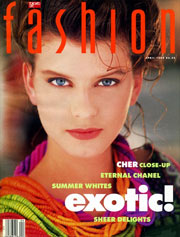
1989 Fashion Magazine Cover
Designers in one case again created clothes that faithfully followed the lines of the body. Popular colors in 1989 were plums, gold and brilliant wines. Animal prints were besides a pop choice for women.
Dresses and skirts could be whatever length, either stopping inches higher up the human knee or plunging all the mode to the ankles. Coats made of cloth and fake fur received a sales heave thank you to animal-rights activists who urged women non to purchase the real affair.
Christian Lacroix settled downwards to a more standard way in 1989. He worked to institute ready-to-vesture fashions to complement his flamboyant made-to-order styles.
Designers in the U.Southward. had a very successful yr 1989. Donna Karen's sexy interpretations of American sportswear and her DKNY collection of casual weekend clothes were a huge hit both in the U.S. and Europe.
Calvin Kline and Ralph Lauren both had very good year and were capturing more overseas business daily.
Bill Blass and Oscar de la Renta were the summit evening habiliment designers.
In May, Dior chose Italian designer Gianfranco Ferre to blueprint both its couture and ready-to-wearable collections. Ferre replaced Marc Bohan, who had been with Dior since 1960.
Fendi, the Roman fashion business firm best known for the fur coats, released reversible coats that could be worn either leather side out or fur side out. The coats were made without linings.
1980s Women's Fashion Pictures
CLICK Image TO Overstate
1980s Fashion for Women Video
1980s Manner for Men Video
1980s Men's Manner Pictures
CLICK IMAGE TO ENLARGE
Advertisements from Catalogs (Men & Women)
CLICK Prototype TO Overstate
0 Response to "30s and 40s War 40s Fashion"
Post a Comment